Home/Blogs & Insights/How to Build a Content Strategy for Google, AI Search Engines and Real Customers at the Same Time
AI Search Optimization
How to Build a Content Strategy for Google, AI Search Engines and Real Customers at the Same Time
Content written only for algorithms is generic. Content written only for AI is the same problem in a different wrapper. The Three-Audience Content Model and Content Value Stack show how to serve all three simultaneously.
Vince Beekel
Jul 24, 202614 min read
Table of Contents
Businesses have spent years writing content for search engine algorithms. Now some want to write exclusively for AI engines. Neither approach is sufficient. Content written only for algorithms tends to be generic, robotic, and forgettable. Content written only for AI systems risks the same problem in a different wrapper. The content that performs best across traditional search, AI discovery, and actual buyer decision-making is content written primarily for humans, structured so that its meaning is unambiguous to any system that reads it.
This article provides a practical framework for building content that serves all three audiences simultaneously without producing robotic SEO content or thin AI-generated pages. For the broader context of how content fits into search visibility, read our complete guide to Multi-Engine Optimization. For Google's stance on AI-assisted content specifically, see whether Google penalizes AI-generated content.
The Three-Audience Content Model
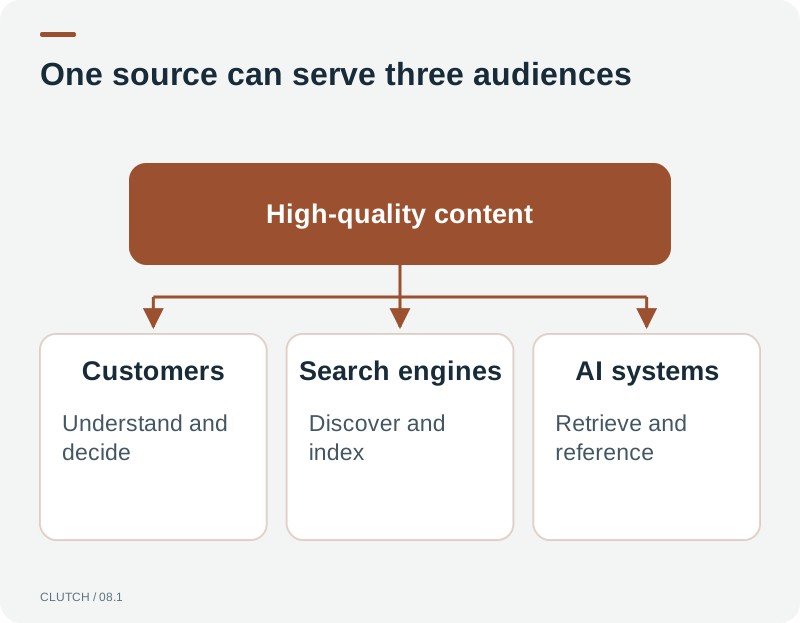
Every important content asset should serve three audiences. These audiences overlap considerably, and the goal is not to write separate versions for each. The goal is to produce one piece of content that satisfies all three simultaneously. Understanding what each audience needs helps you evaluate whether your content is complete.
The Three-Audience Content Model serves customers, search engines, and generative systems from one high-quality content source.The three audiences overlap significantly. One well-structured piece of content can serve all three without separate versions.
Audience 1: The Customer
The primary audience is always the human reader. Does this content help someone understand, compare, decide, or act? Does it answer their actual question in a way that is clear, useful, and trustworthy? If the content does not serve the customer, no amount of technical optimization will make it valuable. Customer-first content is the foundation. Everything else builds on it.
Audience 2: The Search Engine
Can the page be crawled, indexed, understood, and matched to relevant searches? This audience requires technical accessibility, clear heading structure, proper internal linking, and content that aligns with search intent. The search engine does not need to be entertained. It needs to be able to access, understand, and match your content to the right queries. This is where traditional SEO fundamentals apply.
Audience 3: The Answer or Generative System
Is the information sufficiently clear, structured, specific, credible, and useful to support an answer? Generative systems that synthesize responses need content that provides precise, well-supported information they can extract and reference. This audience rewards concise direct answers, clear definitions, original data, and content that offers something unavailable elsewhere. It does not reward vague, generic, or duplicated material.
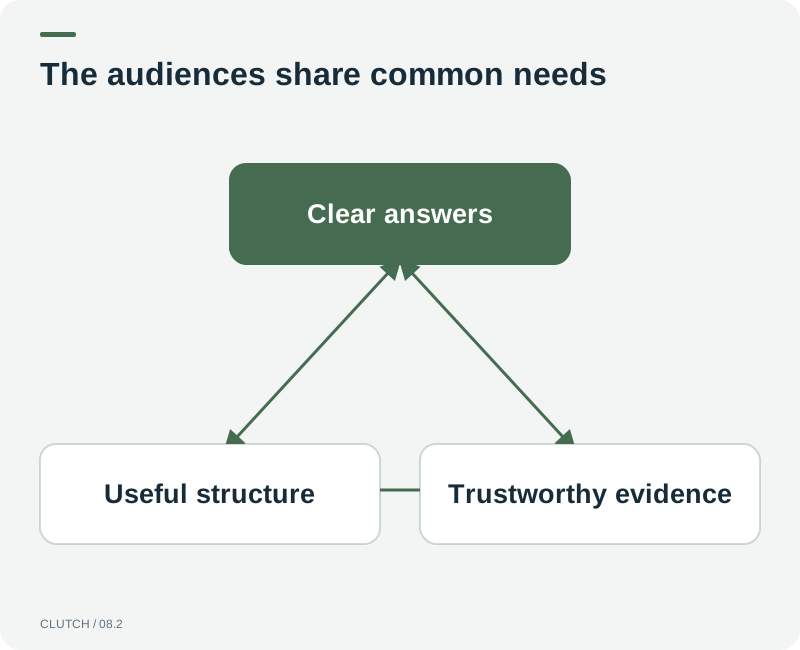
The overlap between these audiences is significant. Content that genuinely serves the customer, if it is well-structured and technically accessible, also serves search engines and generative systems. The model is not about writing three different versions. It is about evaluating your content against three sets of requirements and ensuring it meets all of them.
The Clutch Content Value Stack
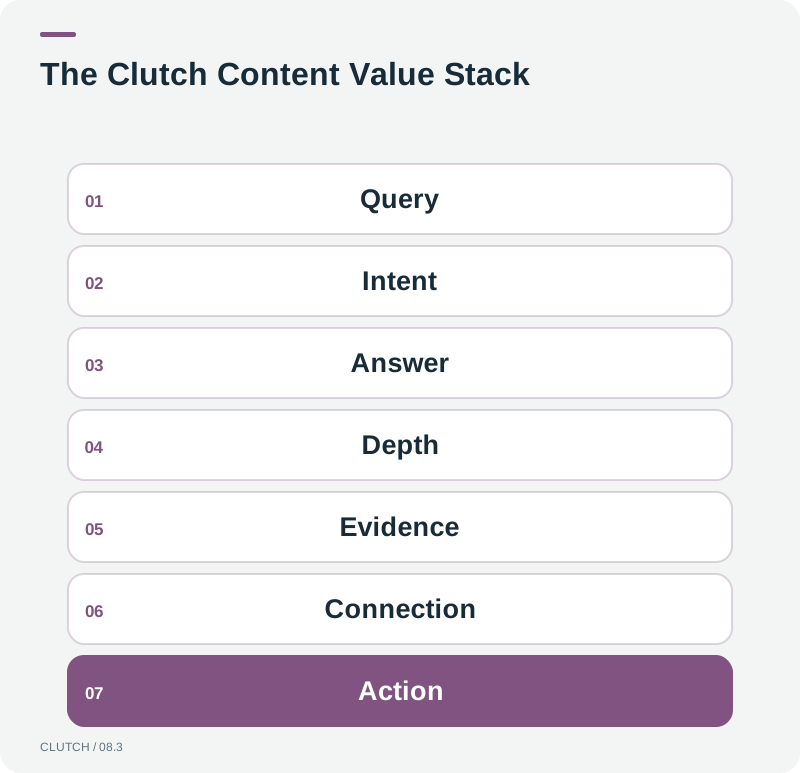
Within the Three-Audience Model, each important content asset should follow a value stack that ensures it provides complete, useful information. The stack is sequential. Each layer builds on the one before it, and skipping layers produces content that is incomplete.
The Clutch Content Value Stack ensures content provides complete value from the initial query through to the logical next action.
1. Query
What does the audience actually want to know? Start with the real question, not the keyword. Keyword research tools tell you what people type, but they do not always reveal the underlying need. Talk to your sales team, review customer emails, and listen to the questions prospects ask during calls. The query layer is about understanding the real information need.
2. Intent
Why are they asking? Someone searching AC repair cost may be comparing options, budgeting for a repair, or deciding whether to replace their system entirely. The intent behind the query shapes what the content should cover. A page that answers the literal question without addressing the underlying intent will rank but fail to convert.
3. Answer
What is the clearest useful response? Provide a direct answer early in the content. For question-based content, place a concise answer of 40 to 80 words immediately beneath the question heading. This serves the customer who wants a quick answer, the search engine that matches content to queries, and the generative system that extracts answers.
4. Depth
What additional context helps them make a decision? After the direct answer, provide the deeper explanation that helps the reader understand the nuances, factors, and considerations. Depth is what separates a useful resource from a shallow answer. It is also what gives generative systems enough context to understand the topic thoroughly.
5. Evidence
What proof, expertise, examples, sources, or data support the answer? Evidence transforms claims into credible information. Original research, case studies, expert commentary, and citations to authoritative sources all contribute. Evidence is what makes content citation-worthy, as we explain in our article on building citation-worthy authority.
6. Connection
What related pages should the reader explore? Internal linking connects your content into a topical cluster that helps both users and systems understand the relationships between pieces of content. A reader who finishes an article should have a clear path to the next relevant resource. A search engine or AI system should be able to follow links to understand the full scope of your expertise.
7. Action
What is the logical next step? Content that informs but never guides toward action produces readers without leads. Every important content asset should connect to a clear next step, whether that is requesting a quote, booking a consultation, contacting the team, or exploring a related service. The action layer connects content to business outcomes.
How to Choose Topics
Topic selection should start with customer questions and sales-call objections, not keyword volume. The most valuable content addresses the questions your prospects actually ask during the buying process. These topics may not always have the highest search volume, but they have the highest relevance to people who are considering your services.
Combine customer input with keyword research. Use keyword tools to understand how people search for the topics you have identified, but do not let search volume alone dictate your topic choices. A topic with lower volume but high commercial relevance is more valuable than a high-volume topic with no connection to your services. The goal is content that serves the customer journey, not content that maximizes traffic.
Pillar and Cluster Architecture
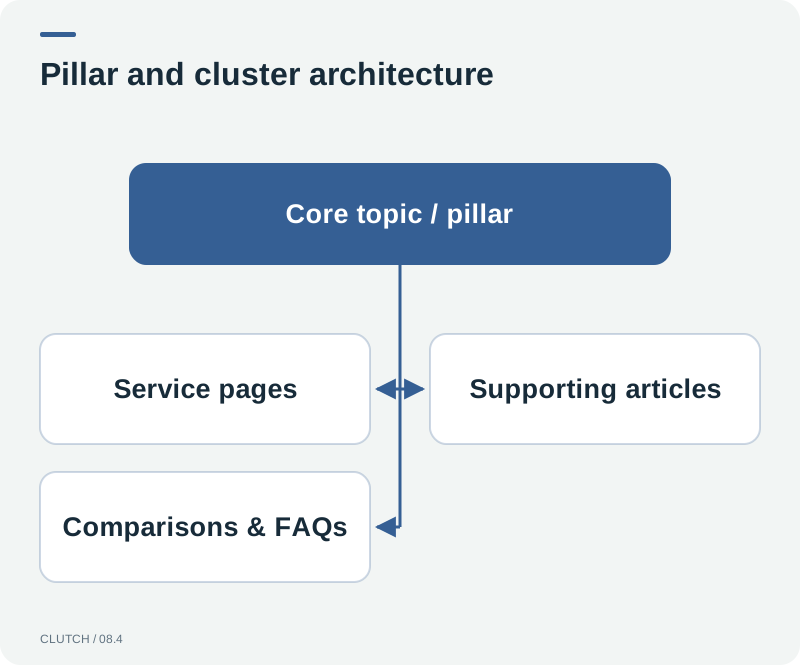
Content should be organized into topical clusters rather than published as disconnected articles. A pillar page covers a broad topic comprehensively. Supporting pages and articles address specific subtopics in depth, each linking back to the pillar and to each other. This architecture helps search engines understand your topical authority and gives generative systems multiple entry points for discovery.
Pillar and cluster architecture connects a core topic to supporting pages, creating topical authority and multiple discovery entry points.
Sample Architecture: HVAC Company
The following is a hypothetical example to illustrate how pillar and cluster architecture works for a service business. It is not based on a real Clutch customer.
The pillar page covers Air Conditioning Services broadly. It links to supporting service pages for AC Repair, AC Replacement, and AC Maintenance. Each service page links to related educational articles that address customer questions: How Much Does AC Replacement Cost, Repair or Replace an AC System, Why Is My AC Running but Not Cooling, and How Long Does an AC Unit Last. The articles link back to the relevant service pages, creating a connected cluster.
This architecture serves all three audiences. Customers find answers to their questions and clear paths to action. Search engines understand the topical relationship between pages. Generative systems encounter the business as a source across multiple related topics, increasing the likelihood of citation for any AC-related query. The informational content supports the commercial service pages naturally, guiding prospects from research toward contact.
How to Avoid Keyword Cannibalization
Keyword cannibalization happens when multiple pages on your site target the same primary keyword, competing with each other in search results. This dilutes authority and confuses search engines about which page to rank. The solution is to assign each important page a clear primary topic and ensure supporting content links to it rather than competing with it.
In the HVAC example, the AC Replacement service page owns the commercial intent for AC replacement. The article How Much Does AC Replacement Cost addresses informational intent and links to the service page. They do not compete because they serve different intents. The article answers a question. The service page offers a solution. This distinction prevents cannibalization while building topical depth.
How to Produce Information Gain
Information gain is the element that makes your content worth reading, ranking, and citing. It is the original information, perspective, or analysis that your content provides beyond what is available elsewhere. Without information gain, your content is interchangeable with every competitor's content, and no system, human or machine, has a reason to prefer it.
Information gain comes from several sources. Original research based on your own data or experience. Expert commentary that provides analysis unavailable from generic sources. Proprietary frameworks that organize information uniquely. Case studies with specific, verifiable results. First-hand experience that adds credibility and specificity. The common thread is that the content contributes something that could not be produced by anyone with the same tool and the same prompt.
How to Structure Content for All Three Audiences
Practical structural choices serve all three audiences simultaneously. Use one clear H1 that states the topic. Use H2 headings for major sections, with H3 only as children of an H2. Place concise direct answers of 40 to 80 words beneath question-based headings. Use comparison tables where they make information easier to understand. Use ordered lists for processes and unordered lists for items where order does not matter.
Do not turn the entire article into lists. Prose is better for explanation, context, and nuance. Lists are better for steps, items, and quick reference. Use each format where it genuinely serves the reader. Include internal links with descriptive anchor text, not click here. Cite authoritative sources for factual claims using contextual anchor text. Add images with descriptive alt text that accurately describes what the image represents.
What Should You Not Do?
Several common practices undermine content performance across all three audiences. Recognizing them helps you avoid producing content that wastes effort.
Mass-producing thin content with the primary goal of capturing search traffic rather than serving readers
Rewriting competitor pages without adding original information, expertise, or perspective
Stuffing keywords into content in ways that make it read unnaturally
Creating nearly identical city or location pages with only the city name changed
Publishing unverified AI-generated information without fact checking or editorial review
Creating content without understanding customer intent, producing pages that rank but do not convert
Publishing disconnected blog articles that do not link to service pages or related content
Ignoring internal linking, leaving content isolated instead of connected into topical clusters
Writing for AI systems instead of customers, producing content that is technically optimized but humanly useless
Obsessing over arbitrary word counts instead of focusing on whether the content is complete
How to Measure Content Performance
Content performance should be measured against business outcomes, not just traffic metrics. Track organic traffic to each important page, but also track what visitors do after arriving. Do they convert? Do they explore related pages? Do they return? Connect content metrics to lead generation, appointment booking, and revenue attribution.
For AI search visibility, monitor whether your content appears in AI-generated answers for relevant queries. Track referral traffic from AI platform domains. Watch for increases in branded search that may indicate your content is being referenced by generative systems. For a comprehensive measurement approach, read our guide to the Multi-Engine Visibility Audit.
Review content performance quarterly. Identify which pages produce leads and which do not. Update high-performing pages to maintain their accuracy and freshness. Consolidate or improve underperforming pages rather than leaving them to drift. Content is not a one-time publication. It is an asset that requires maintenance to continue producing value.
Frequently Asked Questions
Frequently Asked Questions
Do I need separate content for SEO and AI search?
No. The same content that serves traditional search intent, if it is well-structured, original, and authoritative, also supports AI search visibility. The Three-Audience Content Model shows that content written for customers, structured for search engines, and organized for generative systems can be one piece of content. The key is addressing all three sets of requirements rather than writing separate versions.
How do I choose topics for my content strategy?
Start with customer questions and sales-call objections, not keyword volume. The most valuable content addresses what prospects actually ask during the buying process. Combine customer input with keyword research to understand how people search, but let relevance to your services guide topic selection rather than search volume alone.
What is pillar and cluster content architecture?
A pillar page covers a broad topic comprehensively. Supporting pages and articles address specific subtopics in depth, each linking back to the pillar and to each other. This creates topical authority, helps search engines understand your expertise, and gives generative systems multiple discovery entry points.
How do I avoid keyword cannibalization?
Assign each important page a clear primary topic and ensure supporting content links to it rather than competing with it. If a service page owns commercial intent for a topic, supporting articles should address informational intent and link to the service page. They serve different intents and do not compete.
What is information gain and why does it matter?
Information gain is the original information, perspective, or analysis your content provides beyond what is available elsewhere. Without it, your content is interchangeable with competitors. Information gain comes from original research, expert commentary, proprietary frameworks, case studies, and first-hand experience. It is what makes content worth ranking, reading, and citing.
Should I use AI to write my content?
AI can assist within a human-directed process that includes research, expertise, editing, and fact checking. The risk arises when AI drafts are published without review or when content is mass-produced for search traffic. Google's guidelines focus on content quality and purpose, not the tool used. Read our article on Google and AI-generated content for details.
How long should my blog articles be?
Length should follow informational depth, not an arbitrary word count. A 2,400-word article with complete coverage of the topic is better than a 3,500-word article with repetitive filler. Focus on whether the content fully addresses the query, intent, and supporting context rather than hitting a specific word count.
How often should I update my content?
Review content performance quarterly. Update high-performing pages to maintain accuracy and freshness. Consolidate or improve underperforming pages. Content is an asset that requires maintenance to continue producing value. Identify your most valuable, most discoverable pages and keep them current.
Build a content system designed around outcomes
Content that serves customers, search engines, and generative systems simultaneously is content that produces visibility, leads, and revenue. Clutch Digital Development builds content strategies connected to smart websites, AI Sales Agents, and CRM automation so every piece of content contributes to measurable business growth.
Tags:#AI content strategy#SEO content strategy#content strategy for AI search#content strategy for Google#GEO content strategy#AEO content strategy#modern content strategy#content optimization for AI search
READY TO PUT AI TO WORK?
What Could an AI Sales Agent Do for Your Business?
Every business handles leads differently. We'll look at your current sales process, lead volume, response times, follow-up, staffing, and opportunities to determine where an AI Sales Agent could have the biggest impact.
Search discovery expanded beyond a single results page. Multi-Engine Optimization is the framework for staying visible across organic search, AI answers, conversational platforms, and more without abandoning proven SEO fundamentals.
Confused by the alphabet soup of modern search optimization? This plain-English comparison breaks down SEO, AEO, GEO, and AIO, where they overlap, and what your business should prioritize.
Google does not penalize content simply because AI assisted in creating it. The real risk is scaled content abuse, not the tool. Learn what Google's guidelines actually say and how to use AI safely.