Home/Blogs & Insights/SEO Isn't Dead. It Multiplied: The Complete Guide to Multi-Engine Optimization
AI Search Optimization
SEO Isn't Dead. It Multiplied: The Complete Guide to Multi-Engine Optimization
Search discovery expanded beyond a single results page. Multi-Engine Optimization is the framework for staying visible across organic search, AI answers, conversational platforms, and more without abandoning proven SEO fundamentals.
Vince Beekel
Sep 12, 202612 min read
Table of Contents
A business that ranked first on Google five years ago could still be invisible to a prospect who asks ChatGPT for a recommendation, checks Perplexity for a comparison, or reads a Google AI Overview before clicking anything. The prospect found an answer. They just did not find you. Search did not die. It multiplied, and the companies treating that as a problem instead of an opportunity are the ones losing ground.
Multi-Engine Optimization is the framework Clutch Digital Development uses to describe a broader approach to search visibility, one that accounts for traditional organic search, AI-generated answers, conversational search platforms, map listings, and other discovery environments simultaneously. The goal is not to abandon SEO. The goal is to stop pretending a single ranking position is the only place a customer can find a business.
This guide breaks down what changed, why it matters, and what a practical Multi-Engine Optimization strategy actually involves. If you want the comparison of specific optimization disciplines, read our breakdown of SEO vs. AEO vs. GEO vs. AIO. If you want implementation steps for AI search platforms, see how to get your business found in ChatGPT, Google AI Mode, Gemini, and Perplexity.
What Is Multi-Engine Optimization?
Multi-Engine Optimization is a strategic framework for increasing a business's visibility across multiple types of search, answer, and discovery platforms rather than focusing exclusively on traditional organic search rankings. It groups related disciplines like SEO, Answer Engine Optimization, Generative Engine Optimization, and broader AI search visibility into one coordinated effort. The term is Clutch's own framework, not an official Google designation, and it reflects how discovery behavior has expanded beyond a single search results page.
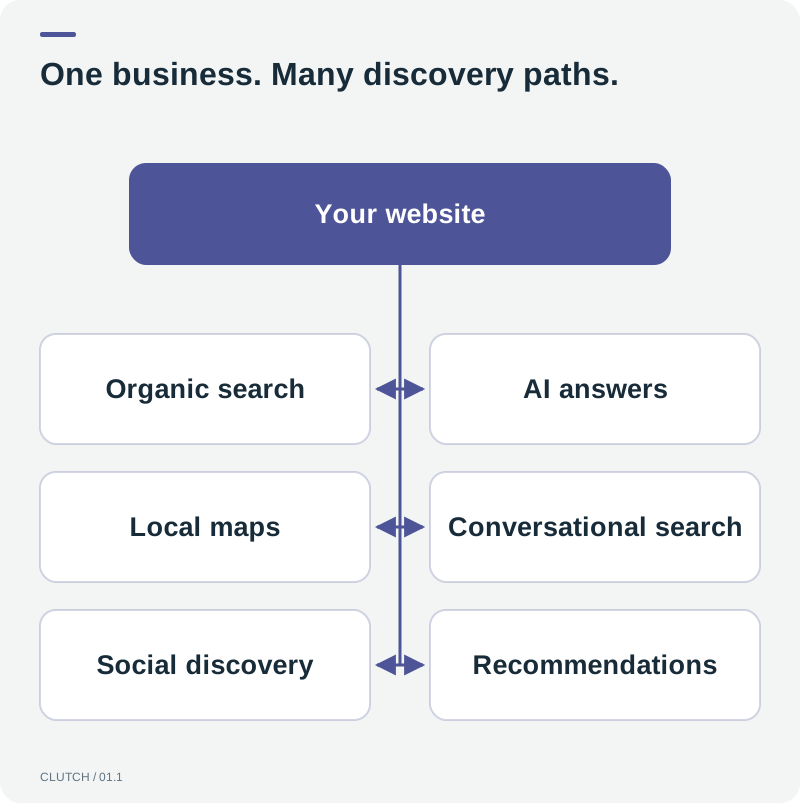
The premise is straightforward. People no longer start every inquiry at the same input box and click the same blue links. Some ask a conversational AI assistant. Some read an AI-generated summary at the top of a results page. Some check maps for a nearby provider. Some search a social platform. Each of those is a discovery engine, and each rewards slightly different signals. Multi-Engine Optimization is the practice of making sure a business is discoverable, understandable, and compelling across the ones its customers actually use.
Search discovery has expanded from a single channel into an interconnected ecosystem of engines and answer platforms.
Why SEO Did Not Die
Every few months a headline announces that SEO is dead. The reasoning usually points to AI Overviews, conversational search, or declining organic click-through rates on certain query types. The conclusion is understandable but wrong.
Traditional search engine optimization remains foundational. Search engines still crawl, render, index, and rank web pages. Technical accessibility, content quality, internal linking, structured data, and site architecture still determine whether a business can be discovered at all. The systems generating AI answers often retrieve information from the same indexed web content that traditional SEO helps surface. A site that cannot be crawled or understood by a search engine is unlikely to be surfaced by an AI assistant that draws on similar web sources.
What changed is not the death of SEO but the expansion of discovery. A business can now be found through organic results, AI-generated answers, map packs, conversational platforms, social search, and recommendation feeds. Each environment uses different signals to decide what to show. SEO is one critical layer of a broader visibility strategy, not the whole strategy.
Companies that abandon SEO to chase the latest acronym tend to trade a proven discipline for an unproven one. Companies that ignore new discovery environments tend to lose prospects they never knew they had a chance to reach. Multi-Engine Optimization is the middle path: keep the technical and content foundations strong, then extend visibility into the places customers actually look.
The Four Layers of Modern Search Visibility
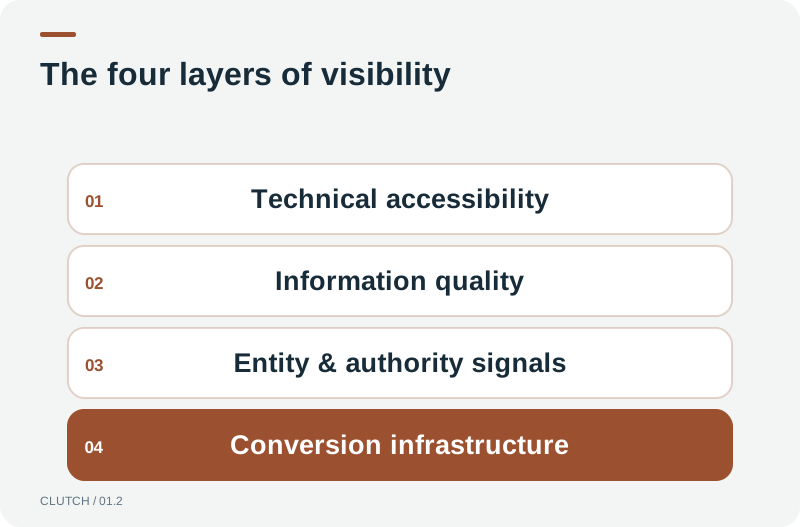
Clutch organizes Multi-Engine Optimization around four layers. Each layer builds on the one before it, and skipping a layer weakens everything above it. This structure helps businesses avoid the common mistake of jumping to tactics without first confirming the fundamentals are in place.
The Four Layers of Modern Search Visibility form a foundation that supports discovery across every engine.
Layer 1: Technical Accessibility
Before any engine can rank, cite, or recommend a business, it has to be able to access the content. That means the site is crawlable, renders properly, loads reasonably fast, has clean URL structures, uses canonical tags correctly, and provides an XML sitemap. JavaScript-heavy sites that block rendering can be invisible to crawlers that do not execute scripts fully. Pages blocked by robots.txt or buried behind poor internal linking may never be discovered at all.
Technical accessibility is unglamorous and frequently neglected, but it is the gate every other layer passes through. A beautifully written article that cannot be crawled will not appear in organic results, AI Overviews, or conversational search. If you are unsure whether your site has accessibility problems, a technical audit is the right starting point before any content or authority work.
Layer 2: Information Quality
Once a page is accessible, the question becomes whether it genuinely answers the subject better or differently than competing pages. Information quality covers depth, accuracy, originality, clarity, and structure. It includes whether the content addresses real search intent, whether it provides information a reader cannot get from ten identical competitor pages, and whether it is organized with clear headings and logical flow.
Google's guidance has consistently emphasized helpful, people-first content. The same principle applies to AI systems, which tend to select sources that provide clear, well-structured, useful information. Thin pages, duplicated content, and articles that restate what everyone else already said offer little reason for any engine to surface them. Original research, genuine expertise, first-hand experience, and practical implementation guidance all contribute to information quality.
Layer 3: Entity and Authority Signals
Search and AI systems increasingly try to understand entities, meaning real-world things like businesses, people, places, products, and concepts, and the relationships between them. Entity clarity means making it easy for systems to understand who the company is, what it does, where it operates, and why it deserves consideration as a source.
Authority signals include structured data, consistent business information across the web, brand mentions on relevant third-party sites, reviews, industry citations, and a coherent presence across directories and platforms. When a generative system decides whether to cite a business, it often looks for corroborating signals that the business is a legitimate, recognized entity in its category. A company that exists only on its own website with no external presence is harder for an AI system to confidently recommend.
Layer 4: Conversion Infrastructure
Visibility without conversion is just traffic. The fourth layer asks what happens after someone discovers the business. Does the website load quickly and guide the visitor toward a clear next step? Is there a way to request a quote, book an appointment, or start a conversation? Are forms, calls-to-action, and contact paths obvious and functional on mobile?
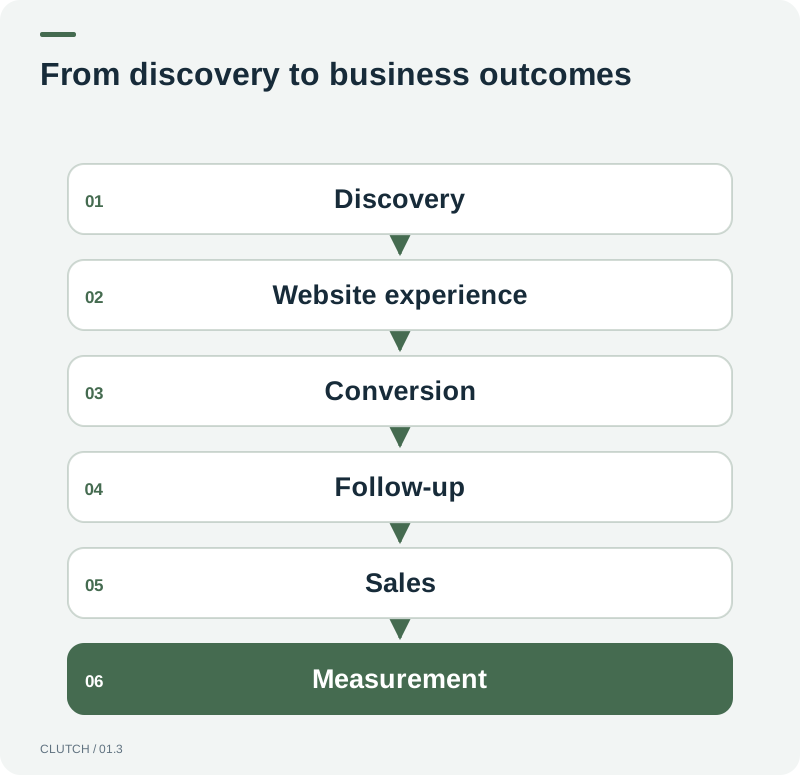
This is where Multi-Engine Optimization connects to the broader growth system Clutch builds for clients. Discovery leads to website experience, which leads to conversion, follow-up, sales, and measurement. A business that improves search visibility but never improves the conversion path will see more visitors without more revenue. The ROI of optimization work depends on whether the site can turn discovery into inquiries.
Discovery is the first stage of a connected growth system that ends with measurable business outcomes.
What a Modern MEO Strategy Actually Involves
A practical Multi-Engine Optimization strategy is not a list of hacks. It is a coordinated set of activities that strengthen each of the four layers while extending presence into the discovery environments a business's customers use. The exact mix depends on the industry, the competitive landscape, and where the target audience actually searches.
For a local home services business, the priority might be Google Business Profile optimization, local search visibility, review generation, and a website that converts phone calls and form submissions. For a B2B software company, the priority might be topical authority through deep content clusters, structured data, third-party industry citations, and presence in AI search results for category-related questions. The framework is the same. The execution differs.
What does not work is treating each engine as a separate, disconnected project. A company that hires one vendor for SEO, another for AI search visibility, and a third for paid search often ends up with fragmented efforts, duplicated work, and conflicting priorities. The technical foundation, content strategy, entity signals, and conversion infrastructure should be managed as one connected system because they all influence each other.
The Role of SEO, AEO, GEO, and AIO Within MEO
Multi-Engine Optimization groups several related disciplines, each addressing a different aspect of modern discovery. Understanding what each one focuses on helps clarify why they work better together than in isolation.
SEO addresses traditional organic search discoverability and performance. It covers technical crawlability, on-page optimization, content quality, internal linking, and authority building. Its primary environment is the search engine results page, including organic listings, local packs, and featured elements.
AEO, or Answer Engine Optimization, focuses on structuring information so it clearly answers questions across answer-oriented experiences. This includes using question-based headings, concise direct answers, structured data, and content formats that make it easy for a system to extract a useful response. AEO is relevant to featured snippets, AI Overviews, and any environment where a system synthesizes an answer from web content.
GEO, or Generative Engine Optimization, generally refers to strategies intended to improve discoverability and citation potential within generative search environments. This includes content clarity, authority signals, original information, and the structural organization that helps a generative model understand and confidently reference a source. GEO does not guarantee inclusion in any specific AI platform, but it improves the conditions under which citation becomes more likely.
AIO, or AI Optimization, is a broader term that varies across the industry. Clutch uses it to describe the overall practice of making a business discoverable, understandable, and compelling across AI-driven search and discovery platforms. It encompasses elements of AEO and GEO but also includes brand presence, entity recognition, and the technical accessibility that allows AI systems to access and process a business's content.
For a detailed comparison of how these disciplines differ and overlap, read our article on SEO vs. AEO vs. GEO vs. AIO. The short version is that they share foundational requirements, particularly technical accessibility and content quality, while emphasizing different discovery environments and signals.
Why Businesses Should Not Abandon SEO
The temptation to chase new acronyms is strong, especially when competitors start talking about AI search and generative visibility. But abandoning proven SEO work to focus exclusively on emerging disciplines creates a different problem.
Traditional organic search still drives a substantial portion of discovery for most businesses. The technical foundations of SEO, crawlability, site speed, structured data, internal linking, and content organization, directly support AI search visibility as well. AI systems that retrieve information from the web rely on the same indexed content that SEO helps surface. A site with strong SEO fundamentals is better positioned for AI discovery than one that ignored SEO in favor of speculative tactics.
The businesses seeing the best results are not choosing between SEO and AI search. They are maintaining strong technical and content foundations while extending their presence into new discovery environments. That is the core idea behind Multi-Engine Optimization.
Practical MEO Checklist
Use this checklist to assess whether your business is covering the fundamentals of Multi-Engine Optimization. Not every item applies to every business, but the list reflects the activities that most commonly influence visibility across multiple engines.
Technical audit completed: site is crawlable, renders properly, loads quickly, and has no major indexing errors
XML sitemap submitted and canonical tags configured correctly
Structured data implemented for business information, articles, FAQs, and services where applicable
Google Business Profile claimed, optimized, and regularly updated with accurate information
Core service and location pages target real search intent with original, useful content
Content organized into topical clusters with clear internal linking between related pages
Question-based content with concise direct answers for common customer inquiries
Consistent business information across directories, review platforms, and industry listings
Review generation strategy in place to build authority and trust signals
Website conversion paths tested and functional on mobile: forms, calls, and booking work
Performance tracking covers organic rankings, AI search visibility, referral traffic from AI platforms, and conversions
Content refreshed periodically to maintain accuracy and relevance
Measurement and KPIs for Multi-Engine Optimization
Measuring Multi-Engine Optimization is more complex than tracking a single ranking position. Because visibility is distributed across multiple environments, no one metric tells the whole story. A practical measurement approach combines several indicators.
Organic search traffic and rankings remain relevant for traditional SEO performance. Referral traffic from AI platforms, visible in analytics as visits from domains associated with ChatGPT, Perplexity, and similar services, provides a signal of AI search visibility. Brand mention monitoring tracks where the business appears across the web, including in AI-generated responses. Conversion metrics, form submissions, calls, appointments, and sales, connect visibility to business outcomes.
The most important shift in measurement is moving from rankings alone to outcomes. A business that ranks first for a keyword but converts poorly is not winning. A business that appears in an AI answer and receives a qualified inquiry is making progress, even if the exact citation is hard to track. The goal of Multi-Engine Optimization is not maximum visibility. It is visibility that connects to measurable business results.
Common Mistakes to Avoid
Several recurring mistakes undermine Multi-Engine Optimization efforts. Recognizing them early saves time and budget.
Treating AI search as a separate project disconnected from SEO and website strategy
Publishing thin, generic content that restates what competitors already say
Ignoring technical accessibility in favor of content production
Overusing structured data in ways that do not match visible page content
Chasing AI citation hacks instead of building genuine authority and useful information
Neglecting conversion infrastructure while focusing only on visibility
Inconsistent business information across directories and platforms
Measuring rankings without tracking conversions or business outcomes
How Clutch Approaches Multi-Engine Optimization
Clutch Digital Development treats Multi-Engine Optimization as part of a connected digital growth system, not an isolated service. We start with technical accessibility, build content that genuinely serves search intent, strengthen entity and authority signals, and ensure the website can convert discovery into inquiries. Where appropriate, we connect visibility work to CRM automation, AI Sales Agents, and follow-up systems so that leads generated from any discovery environment receive a fast, consistent response.
The specific tactics depend on the business. A local service company needs different execution than a national B2B brand. But the framework remains the same: make the business discoverable, understandable, and compelling across the engines its customers use, then convert that visibility into measurable growth. If you want to see how this applies to your business, you can explore our Multi-Engine Optimization services or request a strategy call.
Frequently Asked Questions
Frequently Asked Questions
Is Multi-Engine Optimization an official Google term?
No. Multi-Engine Optimization is Clutch Digital Development's strategic framework for managing visibility across multiple search and discovery platforms. It is not a Google designation. Google's own documentation covers topics like structured data, helpful content, and search fundamentals, but does not use the term MEO.
Does Multi-Engine Optimization replace traditional SEO?
No. Traditional SEO remains a foundational component. MEO extends visibility work beyond organic search rankings to include AI-generated answers, conversational search, map listings, and other discovery environments. The technical and content foundations of SEO directly support visibility across newer engines.
Can you guarantee my business appears in ChatGPT or Google AI Overviews?
No legitimate provider can guarantee inclusion in any specific AI-generated response. Generative systems select sources based on their own processes, which are not fully transparent. What a business can do is improve the conditions that make citation more likely: technical accessibility, content quality, entity clarity, authority signals, and third-party corroboration.
How long does it take to see results from Multi-Engine Optimization?
Technical improvements can show results within weeks. Content and authority building typically take three to six months to produce meaningful visibility changes. AI search visibility is harder to predict and depends on how generative platforms evolve. Consistent effort over time produces more reliable results than short bursts of activity.
Do I need different strategies for SEO and AI search?
The foundations overlap significantly. Technical accessibility, content quality, and structured data support both. The differences are in emphasis: AI search rewards concise answers, entity clarity, and authority signals more explicitly. A coordinated strategy addresses both without duplicating effort.
What is the difference between MEO and GEO?
GEO generally refers specifically to improving visibility within generative search environments. MEO is a broader framework that includes GEO along with traditional SEO, AEO, and overall AI search visibility. Think of GEO as one component within the larger MEO approach.
How do I measure AI search visibility?
Track referral traffic from AI platform domains in your analytics, monitor brand mentions in AI-generated responses, and watch for increases in branded search volume. No single metric captures everything, so combine multiple signals and connect them to conversion data.
Should small local businesses invest in Multi-Engine Optimization?
Yes, but with different priorities. Local businesses should focus on Google Business Profile, local search visibility, reviews, and a website that converts. AI search visibility matters increasingly for local queries, but the foundation starts with local SEO and conversion infrastructure.
Ready to expand your search visibility?
Multi-Engine Optimization works best when it is connected to a website that converts and a follow-up system that responds. Clutch Digital Development builds the full system, from technical foundations to AI Sales Agents that engage every lead.
What Could an AI Sales Agent Do for Your Business?
Every business handles leads differently. We'll look at your current sales process, lead volume, response times, follow-up, staffing, and opportunities to determine where an AI Sales Agent could have the biggest impact.
Confused by the alphabet soup of modern search optimization? This plain-English comparison breaks down SEO, AEO, GEO, and AIO, where they overlap, and what your business should prioritize.
There is no guaranteed switch for AI search visibility, but there is a practical set of things businesses can control. This implementation guide covers the AI Visibility Stack and step-by-step actions for being discovered and cited.
Google does not penalize content simply because AI assisted in creating it. The real risk is scaled content abuse, not the tool. Learn what Google's guidelines actually say and how to use AI safely.