Home/Blogs & Insights/Does Google Penalize AI-Generated Content? What Google's Current Guidelines Actually Say
AI Search Optimization
Does Google Penalize AI-Generated Content? What Google's Current Guidelines Actually Say
Google does not penalize content simply because AI assisted in creating it. The real risk is scaled content abuse, not the tool. Learn what Google's guidelines actually say and how to use AI safely.
Vince Beekel
Aug 21, 202610 min read
Table of Contents
The question comes up in nearly every conversation about content strategy: will Google penalize my website if I use AI to write articles? The concern is reasonable. Businesses have invested years in organic search visibility, and the fear of losing it overnight to a penalty is enough to make anyone cautious about adopting new tools.
The answer is more nuanced than a simple yes or no, and understanding the nuance matters because it determines whether AI-assisted content helps or hurts your search performance. This article explains what Google's current guidelines actually say, where the real risks lie, and how to use AI in content production without creating problems for your search visibility.
For the broader context of how search has evolved, read our complete guide to Multi-Engine Optimization. This article focuses specifically on Google's stance on AI-generated content and what it means for your content strategy.
Does Google Penalize AI-Generated Content?
Google does not penalize content simply because AI assisted in creating it. Google's guidance focuses on the quality, usefulness, originality, and purpose of content rather than the specific tools used to produce it. Content created with AI assistance can perform well in search if it is helpful, accurate, and serves the reader's intent. However, Google's spam policies do address scaled content abuse, which includes mass-producing content primarily to manipulate search rankings, regardless of whether AI or humans produce it. The risk is not AI itself but low-quality, mass-produced content created to game search results.
This distinction is critical. Google evaluates content based on whether it provides value to people, not on whether a particular tool was involved in its creation. A well-researched, expertly edited article that used AI for drafting can rank well. A page of thin, generic, mass-produced text will struggle regardless of how it was made.
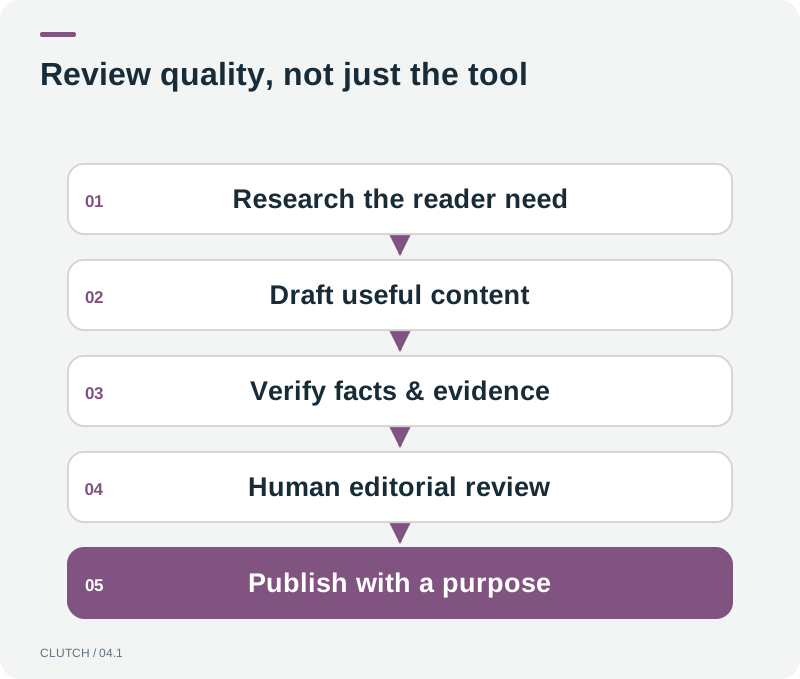
Google's concern is content quality and purpose, not the specific tools used in production.
What Google's Guidelines Actually Say
Google Search Central provides documentation on how the search system evaluates content. The consistent theme across Google's guidance is a focus on helpful, people-first content. Google has stated that automation can be used to create helpful content, and that the key question is whether the content is created primarily for people rather than primarily to manipulate search rankings.
Google's spam policies are where the real risk lies. The policy on scaled content abuse addresses content that is produced at scale, often with automation, with the primary purpose of manipulating search rankings. This is not limited to AI. Mass-producing low-quality content through any method, whether automated or manual, falls under this concern. The policy targets the behavior and the purpose, not the tool.
It is worth reading Google's own documentation directly rather than relying on summaries. Google Search Central publishes guidance on creating helpful content and details its spam policies. The specifics may evolve, so verifying the current documentation before making content strategy decisions is a sound practice. What has remained consistent is the emphasis on content quality, originality, and usefulness over the method of production.
The Real Risk: Scaled Content Abuse, Not AI Itself
The businesses that get into trouble with AI content are rarely those using AI thoughtfully as part of a quality content process. They are typically those mass-producing large volumes of thin, generic content with the primary goal of capturing search traffic. This pattern, producing hundreds or thousands of low-effort pages to game rankings, is what Google's spam policies target.
The risk is not that AI was involved. The risk is that the content was created primarily to manipulate search results rather than to serve readers. A business that publishes ten well-researched, expertly edited articles per month is in a very different position than one that publishes five hundred unedited AI-generated pages per week. The tool is the same. The purpose and quality are completely different.
This is why the distinction between AI-assisted content and mass-produced AI spam matters so much. AI-assisted content, where AI supports research, drafting, or optimization within a human-directed process, can be high quality and perform well. Mass-produced AI content, where the goal is volume and keyword capture rather than reader value, is what creates penalty risk.
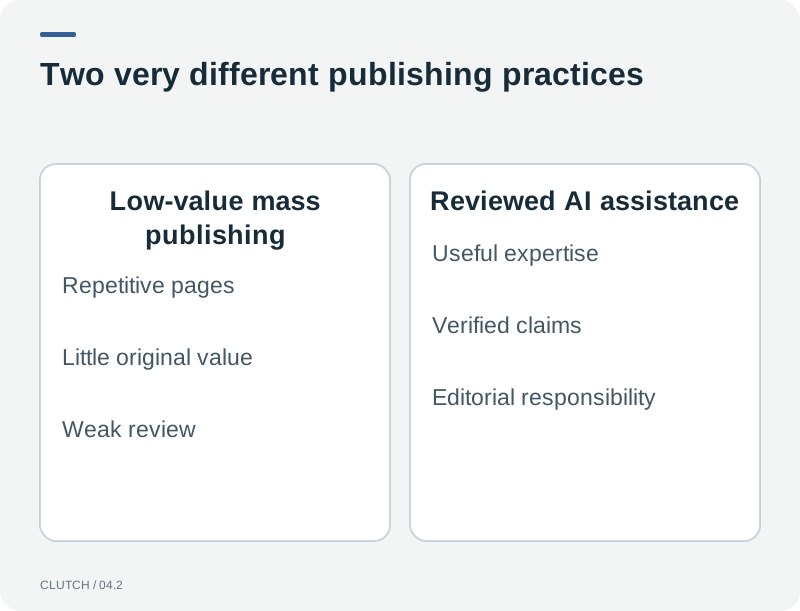
Low-value mass publishing and professionally reviewed AI-assisted content are fundamentally different practices.
Low-Value AI Content vs. High-Value AI-Assisted Content
Understanding the difference between low-value and high-value AI content is the practical key to using AI safely. The comparison below illustrates the distinction.
Dimension
Low-Value AI Content
High-Value AI-Assisted Content
Purpose
Capture search traffic at volume
Serve reader intent with useful information
Research
Minimal or none
Search, audience, and source research conducted
Expertise
Generic, no subject-matter input
Informed by subject-matter expertise and experience
Editing
Published as-is or lightly edited
Human editing for clarity, accuracy, and voice
Originality
Restates what competitors already say
Adds original analysis, frameworks, or data
Accuracy
Often unverified claims
Facts checked and sources verified
Volume
High volume, low effort per piece
Moderate volume, high effort per piece
Reader value
Little to none
Substantial and practical
The Clutch Human-in-the-Loop Content Process
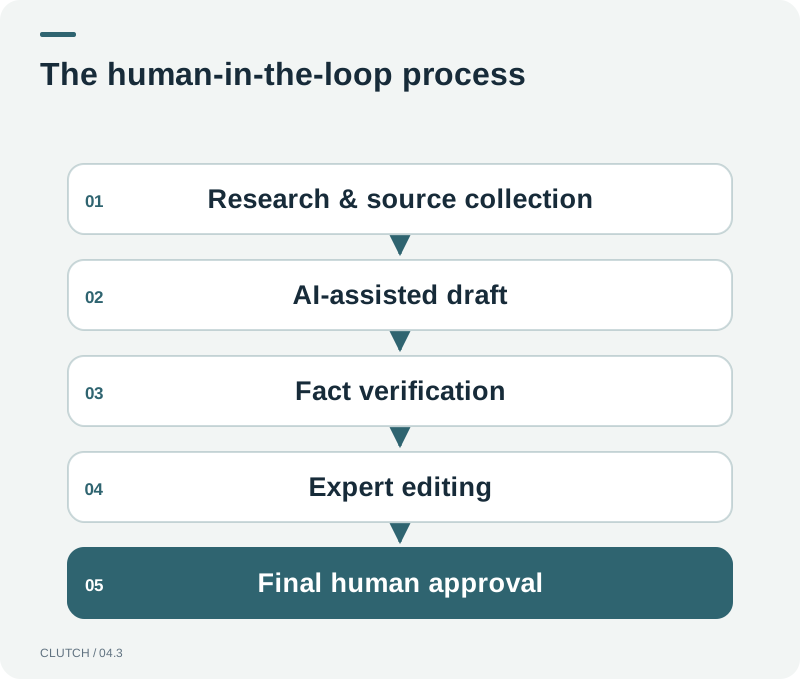
Clutch uses a structured content process that incorporates AI assistance within a human-directed workflow. The goal is to capture the efficiency of AI while maintaining the quality, accuracy, and originality that search engines and readers value. The process below illustrates how AI-assisted content production can work when quality control is built in.
Each step serves a specific purpose, and skipping steps is where quality tends to degrade. The process is not about adding bureaucracy. It is about ensuring that AI assistance produces content that genuinely serves the reader and performs well in search.
The Clutch Human-in-the-Loop Content Process integrates AI assistance with professional oversight at every stage.
Search and audience research: Identify what real people are asking, what intent the content should serve, and what existing content covers the topic.
Subject-matter input: Incorporate expertise, experience, and perspective that AI alone cannot provide. This is where originality begins.
Source verification: Identify authoritative sources for any factual claims, statistics, or external references. Verify before publishing.
Draft development: Use AI to assist with drafting, structuring, or expanding the content based on the research and subject-matter input.
Human editing: Review and revise the draft for clarity, flow, accuracy, and natural voice. Remove generic language and strengthen weak sections.
Brand voice review: Ensure the content matches the brand's tone, positioning, and communication style.
SEO and answer optimization: Structure headings, internal links, and answer formats to serve search intent and answer extraction.
Fact checking: Verify all claims, statistics, and references one final time before publication.
Internal linking: Connect the article to related content, service pages, and other resources to build topical authority.
Publication: Publish the article with proper metadata, structured data, and image optimization.
Indexing review: Confirm the article is crawlable and indexed. Monitor for any technical issues.
Performance improvement: Track performance, gather feedback, and update the content over time to maintain accuracy and relevance.
What Google Actually Evaluates
Google's search systems evaluate a range of signals to determine content quality. While the exact algorithms are not public, Google's published guidance emphasizes several factors that are relevant to AI-assisted content.
Helpfulness is central. Does the content genuinely help the reader accomplish what they came to do? Content that provides practical, actionable information tends to be valued over content that is vague or superficial. Originality matters. Does the content offer something not available elsewhere, or does it merely restate existing information? First-hand experience, original research, and expert analysis all contribute to originality.
Accuracy is evaluated through various signals, including consistency with authoritative sources and the presence of verifiable claims. Content with factual errors or unsupported claims is less likely to perform well. Trust signals, including clear authorship, transparent sourcing, and a coherent brand presence, contribute to how content is evaluated. These factors apply equally to AI-assisted and human-written content. The method of production is not the primary concern. The quality and purpose of the result are.
Common Mistakes With AI Content
Several recurring mistakes create risk when businesses use AI for content production. Recognizing them helps avoid problems.
Publishing AI drafts without human editing, resulting in generic, repetitive, or inaccurate content
Mass-producing content at volume with the primary goal of capturing search traffic rather than serving readers
Failing to verify facts, statistics, and claims generated by AI, leading to inaccuracies
Using AI to restate existing content without adding original information, expertise, or perspective
Ignoring brand voice, producing content that sounds uniform and impersonal across an entire site
Publishing content on topics where the business has no genuine expertise or experience
Failing to structure content for readability, search intent, and answer extraction
Not connecting content through internal links to build topical authority and context
Practical Guidelines for Using AI in Content Production
If you are using AI in your content process, the following guidelines help ensure the content serves readers and performs well in search. They reflect the principles behind Google's guidance and the practices Clutch follows.
Use AI as a tool within a human-directed process, not as a replacement for human judgment. AI can assist with research, drafting, structuring, and optimization, but the strategy, expertise, and quality control should come from people who understand the subject and the audience.
Prioritize quality over volume. Ten well-researched, expertly edited articles will outperform a hundred thin, unedited pages. The temptation to scale content production with AI is strong, but volume without quality creates risk and produces poor results.
Add genuine value that AI alone cannot provide. Original research, first-hand experience, expert analysis, proprietary data, and unique perspectives all make content more valuable to readers and more likely to perform well in search. If an article could be produced by anyone with the same AI tool and the same prompt, it offers little reason for a search engine to prefer it.
Verify everything. AI can produce confident-sounding content that contains factual errors. Check claims, statistics, and references against authoritative sources before publishing. Accuracy is not optional, and unverified AI content is a liability.
Edit thoroughly. AI drafts often contain generic language, repetitive structures, and awkward phrasing. Human editing for clarity, flow, voice, and accuracy is what transforms a draft into publishable content. If you would not publish a human's first draft without editing, the same standard applies to AI drafts.
How This Connects to Broader Search Strategy
Content quality is one component of a broader search visibility strategy. Even the best content will underperform if the technical foundation is weak, if the site cannot be crawled, or if conversion paths are broken. AI-assisted content should be part of a coordinated approach that includes technical SEO, structured data, entity clarity, and conversion infrastructure.
This is why Clutch treats content as part of a connected growth system rather than an isolated activity. Content that is well-researched and well-edited supports traditional SEO, AI search visibility, and conversion. When it is connected to smart website development, CRM automation, and AI Sales Agents, the visibility it generates can be converted into actual business results. For more on how these pieces fit together, read our complete guide to Multi-Engine Optimization.
Frequently Asked Questions
Frequently Asked Questions
Does Google penalize AI-generated content?
Google does not penalize content simply because AI assisted in creating it. Google's guidance focuses on content quality, usefulness, originality, and purpose. Content created with AI assistance can perform well if it is helpful and serves readers. The risk comes from mass-producing low-quality content primarily to manipulate rankings, which Google's spam policies address regardless of the production method.
Is it safe to use AI for writing blog articles?
Yes, if AI is used as a tool within a human-directed process that includes research, subject-matter input, editing, fact checking, and quality control. The risk arises when AI drafts are published without review or when content is mass-produced primarily for search traffic rather than reader value.
What is scaled content abuse?
Scaled content abuse is Google's term for mass-producing content, often with automation, with the primary purpose of manipulating search rankings. It is not limited to AI. The policy targets the behavior and purpose, not the specific tool. Mass-producing low-quality content through any method creates risk.
Will Google know if I used AI to write content?
Google has stated that its focus is on content quality rather than detecting the specific method of production. The relevant question is whether the content is helpful and serves readers, not whether AI was involved. Quality, originality, and purpose matter more than the tool used.
How can I use AI safely in content production?
Use AI within a human-directed process. Conduct research, incorporate subject-matter expertise, verify facts, edit thoroughly, and add original value that AI alone cannot provide. Prioritize quality over volume, and ensure every piece genuinely serves the reader's intent.
Does AI content rank well in Google search?
AI-assisted content can rank well if it is helpful, original, accurate, and well-structured. The same quality standards apply to AI-assisted and human-written content. Content that is thin, generic, or mass-produced will struggle regardless of how it was created.
What is the difference between AI-assisted content and AI spam?
AI-assisted content uses AI as a tool within a quality-controlled process that includes human research, expertise, editing, and verification. AI spam is mass-produced, low-effort content created primarily to capture search traffic. The tool may be the same, but the purpose, quality, and process are completely different.
Should I disclose that I use AI for content?
Google's guidance focuses on content quality rather than requiring disclosure of production methods. However, transparency with your audience about how content is produced can build trust. The most important factor is that the content is accurate, helpful, and genuinely valuable to readers.
Content that performs because it deserves to
AI-assisted content works when it is part of a quality-controlled process that includes research, expertise, editing, and verification. Clutch Digital Development builds content strategies that serve readers and search engines within a connected growth system.
Tags:#does Google penalize AI content#AI generated content SEO#Google AI content guidelines#AI content penalty#scaled content abuse#AI writing SEO#Google spam policies
READY TO PUT AI TO WORK?
What Could an AI Sales Agent Do for Your Business?
Every business handles leads differently. We'll look at your current sales process, lead volume, response times, follow-up, staffing, and opportunities to determine where an AI Sales Agent could have the biggest impact.
Search discovery expanded beyond a single results page. Multi-Engine Optimization is the framework for staying visible across organic search, AI answers, conversational platforms, and more without abandoning proven SEO fundamentals.
Confused by the alphabet soup of modern search optimization? This plain-English comparison breaks down SEO, AEO, GEO, and AIO, where they overlap, and what your business should prioritize.