Home/Blogs & Insights/SEO vs. AEO vs. GEO vs. AIO: What Businesses Actually Need to Know About Modern Search
AI Search Optimization
SEO vs. AEO vs. GEO vs. AIO: What Businesses Actually Need to Know About Modern Search
Confused by the alphabet soup of modern search optimization? This plain-English comparison breaks down SEO, AEO, GEO, and AIO, where they overlap, and what your business should prioritize.
Vince Beekel
Sep 5, 202611 min read
Table of Contents
If you have spent any time reading about modern search, you have encountered the alphabet soup: SEO, AEO, GEO, AIO. Each acronym comes with confident explanations about why it matters, and often with claims that one is replacing another. For a business owner trying to decide where to invest, the terminology can feel like a wall between you and a practical decision.
The reality is less dramatic than the headlines suggest. These are not four competing strategies where you pick one and discard the rest. They are related disciplines that emphasize different aspects of how people discover information online. Understanding the distinctions helps you prioritize. Understanding the overlaps helps you avoid paying for redundant work.
This article provides clear definitions, a comparison table, and practical guidance on what to prioritize. For the broader framework that ties these disciplines together, read our complete guide to Multi-Engine Optimization.
Quick Definitions: SEO, AEO, GEO, and AIO
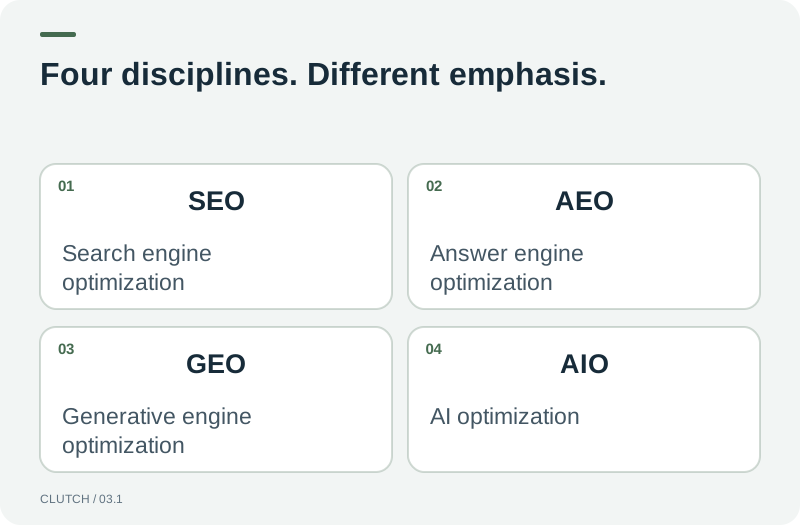
Before diving into comparisons, here are concise definitions of each discipline as Clutch uses the terms. The industry does not always use these consistently, which is part of the confusion, so clarity on definitions matters.
SEO, or Search Engine Optimization, is the practice of improving a website's visibility and performance in traditional organic search results. It covers technical crawlability, on-page content, internal linking, authority building, and user experience. Its primary environment is the search engine results page.
AEO, or Answer Engine Optimization, focuses on structuring content so it clearly and concisely answers questions across answer-oriented search experiences. This includes question-based headings, direct answer formats, and structured data that helps systems extract useful responses. AEO is relevant to featured snippets, AI Overviews, and any environment where a system synthesizes an answer from web content.
GEO, or Generative Engine Optimization, generally refers to strategies intended to improve discoverability and citation potential within generative search environments like AI Overviews, ChatGPT search, and Perplexity. It emphasizes content clarity, authority signals, original information, and structural organization that helps generative models understand and confidently reference a source.
AIO, or AI Optimization, is the broadest and least standardized term. Clutch uses it to describe the overall practice of making a business discoverable, understandable, and compelling across AI-driven search and discovery platforms. It encompasses elements of AEO and GEO but also includes brand presence, entity recognition, and the technical accessibility that allows AI systems to access and process content.
SEO, AEO, GEO, and AIO are distinct disciplines that overlap around shared fundamentals.
Comparison Table: SEO vs AEO vs GEO vs AIO
The table below summarizes how the four disciplines differ across key dimensions. Keep in mind that these are emphases, not rigid boundaries. Strong technical SEO supports AEO and GEO. Well-structured answers support traditional search performance. The overlaps are significant.
Discipline
Primary Goal
Typical Discovery Environment
What It Optimizes
Important Inputs
How Success May Be Measured
SEO
Organic search visibility and rankings
Search engine results pages, local packs
Technical accessibility, content, links, UX
Crawlability, keywords, internal links, authority
Rankings, organic traffic, impressions, clicks
AEO
Clear answers to questions
Featured snippets, AI Overviews, answer panels
Content structure, direct answers, schema
Question headings, concise answers, FAQ schema
Snippet captures, answer-box appearances
GEO
Citation in generative responses
AI Overviews, ChatGPT, Perplexity, Gemini
Content clarity, authority, originality
Entity signals, original data, structured content
AI citations, referral traffic from AI platforms
AIO
Overall AI search discoverability
All AI-driven search and discovery
Brand presence, entity clarity, accessibility
Technical access, brand mentions, content quality
AI referral traffic, brand mention visibility
SEO: Traditional Organic Search
Search Engine Optimization is the discipline most business owners already know. It focuses on making a website discoverable and competitive in traditional organic search results. The work includes technical foundations like site speed, crawlability, and mobile usability, plus content optimization, keyword targeting, internal linking, and authority building through external signals.
SEO remains the backbone of digital visibility for most businesses. Organic search continues to drive significant traffic, and the technical foundations of SEO directly support the other disciplines. A site that cannot be crawled or indexed will struggle in every environment, not just traditional search. This is why SEO is not optional in a Multi-Engine Optimization strategy. It is the base layer.
What has changed is that SEO alone is no longer sufficient for full visibility. A business can rank well organically and still miss prospects who encounter an AI-generated answer before they ever scroll to organic results. SEO addresses one important discovery environment. It does not automatically cover the others.
AEO: Answer Engine Optimization
Answer Engine Optimization focuses on a specific shift in search behavior: people increasingly ask questions and expect direct answers rather than a list of links to evaluate themselves. Featured snippets, AI Overviews, and answer panels all reflect this shift. AEO is the practice of structuring content so it provides clear, concise, useful answers that a system can extract and present.
The practical techniques include using question-based headings, placing a direct answer of roughly 40 to 80 words immediately beneath the question, using structured data like FAQ schema where appropriate, and organizing content so the core answer is easy to identify. The goal is not to game a system but to make genuinely useful information easy to find and present.
AEO overlaps heavily with traditional SEO. Well-structured content that answers questions clearly tends to perform well in organic search too. The distinction is one of emphasis: AEO prioritizes the extractability and clarity of answers, while broader SEO covers ranking factors, technical performance, and authority building.
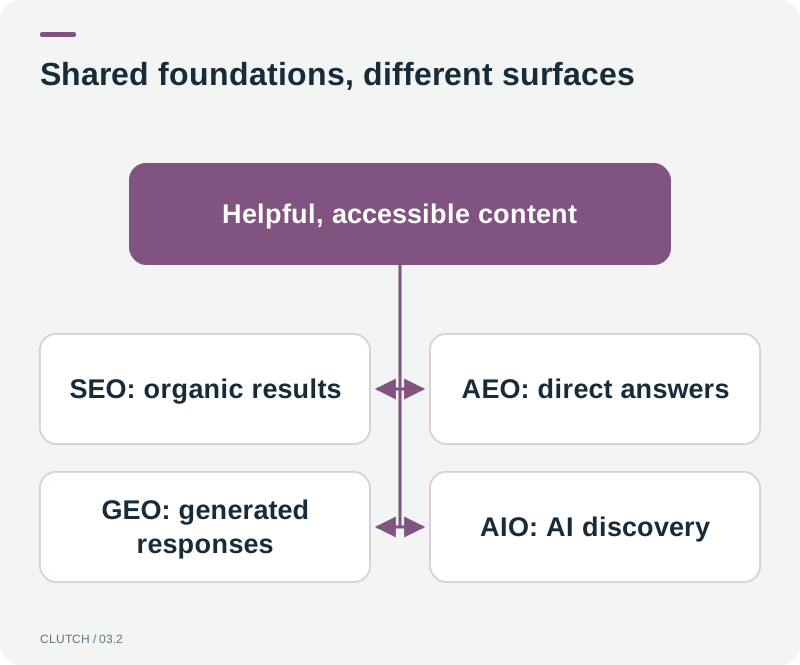
The disciplines share foundational requirements while emphasizing different discovery environments.
GEO: Generative Engine Optimization
Generative Engine Optimization addresses the newest discovery environment: AI systems that generate responses by synthesizing information from multiple sources. When a generative model produces an answer and cites sources, the businesses cited gain visibility. GEO is the practice of improving the likelihood that a business's content is selected and referenced.
Important clarification: GEO does not guarantee inclusion in any specific AI platform's responses. Generative systems select sources through processes that are not fully transparent and that change over time. What GEO can do is improve the conditions that make citation more likely: clear, original, well-structured content; strong entity and authority signals; third-party corroboration; and technical accessibility that allows the content to be retrieved and understood.
GEO shares significant overlap with AEO. Both emphasize content clarity and structure. The difference is that GEO places additional weight on authority signals, original information, and the entity clarity that helps a generative model confidently identify and reference a business as a legitimate source. Original research, expert commentary, and unique data tend to be particularly valuable for GEO because they provide information a generative system cannot find elsewhere.
AIO: AI Optimization
AI Optimization is the broadest term in this set, and the industry does not use it consistently. Some use it interchangeably with GEO. Others use it to describe a wider set of practices. Clutch uses AIO to mean the overall practice of making a business discoverable, understandable, and compelling across AI-driven search and discovery platforms.
Under this definition, AIO encompasses elements of AEO and GEO but extends further. It includes brand presence across the web, entity recognition, consistent business information, technical accessibility for AI crawlers, and the content quality that makes a business worth recommending. AIO is essentially the AI-specific portion of Multi-Engine Optimization.
Because the term varies, it is worth clarifying what any vendor means when they use it. If someone offers AIO services, ask specifically what activities are included. If the answer is vague, that is a signal to dig deeper. A clear provider should be able to explain whether they mean content optimization, technical accessibility, entity building, or a combination.
Where the Disciplines Overlap
The four disciplines are not isolated boxes. They overlap significantly, which is both a source of confusion and a source of efficiency. Understanding the overlaps helps you avoid paying for redundant work and helps you see why a coordinated strategy outperforms fragmented tactics.
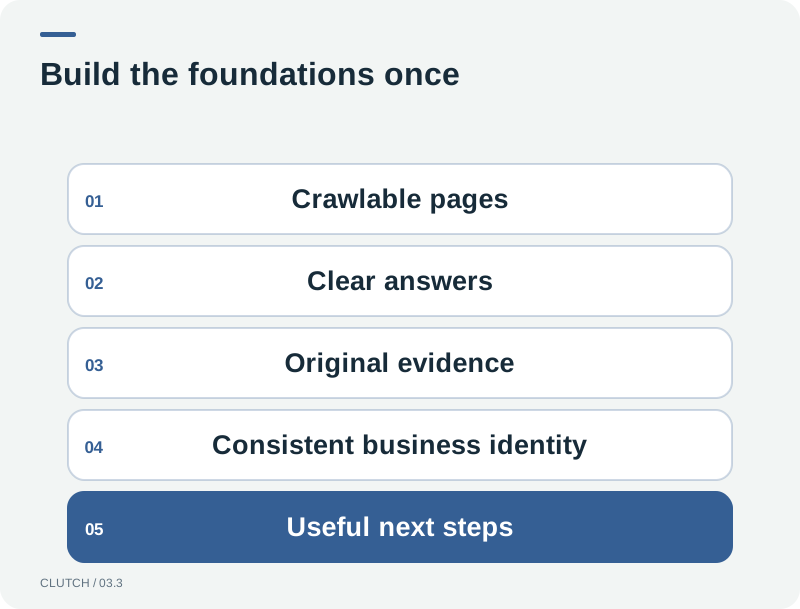
All four share a common foundation: technical accessibility. If a site cannot be crawled, rendered, and understood, none of the disciplines will produce results. This is why technical SEO is not just an SEO concern. It is a prerequisite for AEO, GEO, and AIO as well.
Content quality is another shared requirement. Useful, original, well-structured content serves traditional rankings, answer extraction, generative citation, and overall AI discoverability. A business that invests in genuinely helpful content is simultaneously supporting all four disciplines.
The differences emerge in emphasis and execution. SEO places more weight on ranking signals and authority building through links. AEO prioritizes answer structure and extractability. GEO emphasizes originality, entity clarity, and authority signals for generative citation. AIO takes the broadest view, covering brand presence and technical accessibility across AI platforms. A coordinated strategy addresses the shared foundation once and then applies discipline-specific tactics where they add unique value.
Converging fundamentals mean a coordinated strategy can address all four disciplines efficiently.
What Businesses Commonly Misunderstand
Several misconceptions circulate about these disciplines. Clearing them up helps with prioritization.
The first misconception is that GEO replaces SEO. It does not. Generative systems often retrieve information from the same indexed web content that SEO helps surface. A site with poor SEO fundamentals will struggle with GEO too. The disciplines are complementary, not competitive.
The second misconception is that adding schema markup guarantees AI citations. It does not. Structured data helps systems understand content, which can improve the conditions for citation, but it does not force any platform to reference your business. Schema is a best practice, not a guarantee.
The third misconception is that you need a separate vendor for each discipline. In most cases, this creates fragmentation and duplicated effort. A provider that understands the full picture can manage the shared foundation and apply discipline-specific tactics within one coordinated strategy. This is the approach Clutch takes through Multi-Engine Optimization.
The fourth misconception is that AI search visibility is purely technical. It is not. Content quality, originality, authority, and brand presence matter at least as much as technical implementation. A technically perfect site with thin, generic content will not perform well in any environment.
Do You Need All Four?
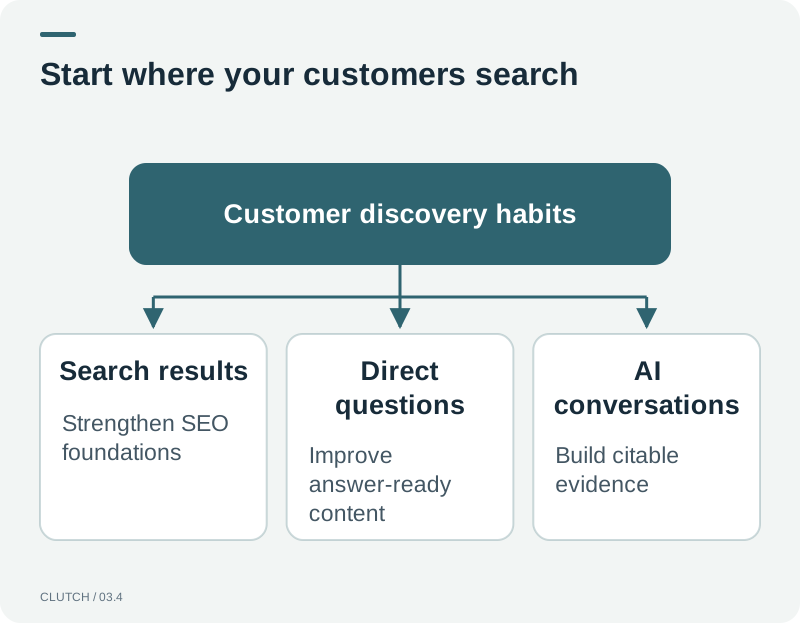
The short answer is that most businesses benefit from addressing all four, but not necessarily with equal effort. The shared foundation, technical accessibility and content quality, serves all of them. Once that foundation is solid, the question becomes which discovery environments matter most for your specific audience.
A local service business might prioritize SEO and local search visibility, with lighter AEO and GEO effort. A B2B software company might prioritize GEO and AEO heavily because its audience researches through AI search and answer panels. An ecommerce brand might focus on SEO and conversion optimization, with AEO for product-related questions. The mix should reflect where your customers actually discover businesses like yours.
Prioritization should reflect where your specific customers actually discover businesses.
What Should a Company Prioritize First?
If you are starting from scratch or reassessing your strategy, the order matters. Jumping to GEO tactics before fixing technical accessibility is like painting a house with a cracked foundation. The sequence below reflects how the layers build on each other.
Fix technical accessibility first. Ensure the site is crawlable, fast, mobile-friendly, and free of major indexing errors. This supports every discipline.
Build content that genuinely serves search intent. Original, useful, well-structured content is the shared requirement for SEO, AEO, GEO, and AIO.
Implement structured data where it accurately represents visible content. This helps systems understand your information.
Strengthen entity and authority signals. Consistent business information, reviews, and third-party mentions build the credibility that supports citation.
Add AEO-specific structure to question-focused content. Concise direct answers under question headings improve extractability.
Pursue GEO tactics for your most valuable topics. Original research, expert commentary, and unique data improve citation potential.
Monitor AI search visibility and adjust. Track referral traffic from AI platforms and brand mentions, then refine your approach.
Can One Strategy Handle All Four?
Yes, and that is generally the most efficient approach. Because the disciplines share foundational requirements, a single coordinated strategy can address the common base and then apply specific tactics for each environment. This avoids the fragmentation that comes from hiring separate vendors who may not communicate or who may duplicate work.
The key is working with someone who understands the full picture rather than a specialist in only one discipline. An SEO-only provider may not address AEO and GEO. A GEO-only provider may neglect technical SEO foundations. A coordinated approach, which is what Multi-Engine Optimization provides, ensures all four are covered without redundancy.
Which Metrics Apply to Each?
Measurement differs by discipline because the discovery environments differ. Using the wrong metrics creates confusion and makes it hard to evaluate whether the work is producing results.
For SEO, track organic rankings, organic traffic, impressions, and click-through rates from search console data. For AEO, monitor featured snippet captures and appearances in answer panels. For GEO, track referral traffic from AI platform domains and monitor brand mentions in AI-generated responses. For AIO, combine AI referral traffic, brand mention visibility, and branded search volume trends.
Across all four, the most important metric is conversions. Visibility that does not connect to inquiries, appointments, or sales is not producing business value. Connect each discipline's visibility metrics to conversion data to understand the actual return on your investment.
Why Technical SEO Still Matters
Technical SEO is the common foundation for all four disciplines, and it remains the most frequently neglected. Many businesses invest in content and AI search tactics while their site has crawlability errors, slow load times, rendering issues, or poor mobile experience. These problems undermine every other effort.
AI systems that retrieve information from the web rely on the same accessible, indexable content that traditional search engines use. A site that blocks crawlers, serves different content to bots, or relies on JavaScript that does not render properly may be invisible to both traditional search and AI discovery. Before investing in advanced tactics, confirm the technical foundation is solid.
This is why Clutch starts every Multi-Engine Optimization engagement with a technical audit. It is not the exciting part, but it is the part that determines whether everything else can work. If you want to understand how technical foundations connect to the broader framework, read our complete guide to Multi-Engine Optimization.
Frequently Asked Questions
Frequently Asked Questions
What is the difference between AEO and GEO?
AEO focuses on structuring content to provide clear answers in answer-oriented experiences like featured snippets and AI Overviews. GEO focuses on improving citation potential within generative search environments like ChatGPT and Perplexity. They overlap significantly, but GEO places more emphasis on authority signals, original information, and entity clarity for generative citation.
Is GEO replacing SEO?
No. GEO and SEO are complementary. Generative systems often retrieve information from the same indexed web content that SEO helps surface. A site with poor SEO fundamentals will struggle with GEO too. Most businesses need both, with the mix depending on where their audience discovers information.
Does adding schema markup guarantee AI citations?
No. Structured data helps systems understand your content, which can improve the conditions for citation, but it does not force any AI platform to reference your business. Schema is a best practice that supports clarity, not a guarantee of visibility.
Do I need separate vendors for SEO, AEO, GEO, and AIO?
In most cases, no. Because the disciplines share foundational requirements, separate vendors often create fragmentation and duplicated effort. A coordinated strategy managed by one provider who understands the full picture is typically more efficient and produces better results.
What should I prioritize first?
Start with technical accessibility, then build genuinely useful content, then implement structured data, then strengthen authority signals. Only after the foundation is solid should you invest heavily in discipline-specific tactics like AEO answer structuring or GEO original research.
How are AEO and GEO different from traditional SEO?
Traditional SEO focuses on ranking in organic search results. AEO focuses on structuring content for answer extraction. GEO focuses on citation potential in generative responses. All three share technical and content foundations but emphasize different discovery environments and signals.
What does AIO mean?
AIO, or AI Optimization, is used inconsistently across the industry. Clutch uses it to describe the overall practice of making a business discoverable across AI-driven search platforms. It encompasses AEO and GEO but also includes brand presence, entity recognition, and technical accessibility for AI systems.
Can I measure AI search visibility?
Yes, though no single metric captures everything. Track referral traffic from AI platform domains, monitor brand mentions in AI responses, and watch branded search volume trends. Connect these signals to conversion data to understand the business impact.
Stop guessing about search optimization
Understanding the disciplines is the first step. Building a coordinated strategy that addresses all of them efficiently is where most businesses need help. Clutch Digital Development manages the full picture through Multi-Engine Optimization.
Tags:#SEO vs AEO#SEO vs GEO#AEO vs GEO#what is AEO#what is GEO#what is AIO#search optimization types
READY TO PUT AI TO WORK?
What Could an AI Sales Agent Do for Your Business?
Every business handles leads differently. We'll look at your current sales process, lead volume, response times, follow-up, staffing, and opportunities to determine where an AI Sales Agent could have the biggest impact.
Search discovery expanded beyond a single results page. Multi-Engine Optimization is the framework for staying visible across organic search, AI answers, conversational platforms, and more without abandoning proven SEO fundamentals.
There is no guaranteed switch for AI search visibility, but there is a practical set of things businesses can control. This implementation guide covers the AI Visibility Stack and step-by-step actions for being discovered and cited.