Home/Blogs & Insights/What Is an AI Sales Agent? The Business Owner's Guide to AI-Powered Sales Teams
AI Automation
What Is an AI Sales Agent? The Business Owner's Guide to AI-Powered Sales Teams
An AI Sales Agent is a software-based sales system that responds, qualifies, educates, advances, and follows up. Learn the Five Jobs framework and whether it fits your business.
Vince Beekel
Jun 5, 202613 min read
Table of Contents
Businesses receive leads through more channels than ever: website forms, phone calls, text messages, email, social media, and online directories. Each lead represents a potential customer, but only if someone responds quickly, qualifies the opportunity, and moves it toward a conversation or a sale. When response times slip, leads go cold. When follow-up is inconsistent, opportunities go to competitors. When qualification is manual, salespeople spend time on prospects who were never a fit.
An AI Sales Agent is one approach to solving this problem. This article explains what an AI Sales Agent is, what it can and cannot do, how it differs from other sales technologies, and whether it makes sense for your business. For the related concept of how websites connect to sales and automation systems, see our guide to Smart Websites.
What Is an AI Sales Agent?
An AI Sales Agent is a software-based sales system that can communicate with prospects, answer approved questions, qualify opportunities, follow up across supported channels, update CRM records, schedule appointments, and hand qualified conversations to human salespeople. It is not a chatbot that answers FAQs. It is not a CRM automation that sends scheduled emails. It is a system that actively participates in the sales process by engaging with prospects in real time across voice, text, email, and chat.
The capabilities of any specific AI Sales Agent depend on its platform, configuration, integrations, knowledge base, communication channels, and business rules. Not every AI Sales Agent possesses every capability described in this article. The technology varies, and the implementation determines what the system can actually do. Businesses should evaluate specific platforms against their own requirements rather than assuming all AI Sales Agents are the same.
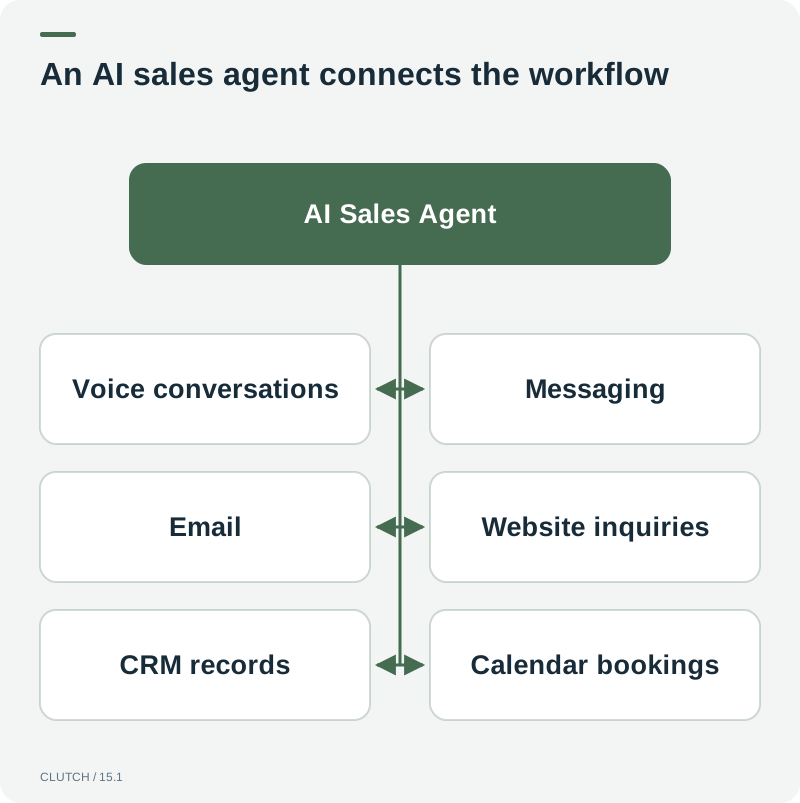
An AI Sales Agent operates across multiple communication channels, integrated with CRM, calendar, and sales workflows.
The Five Jobs of an AI Sales Agent
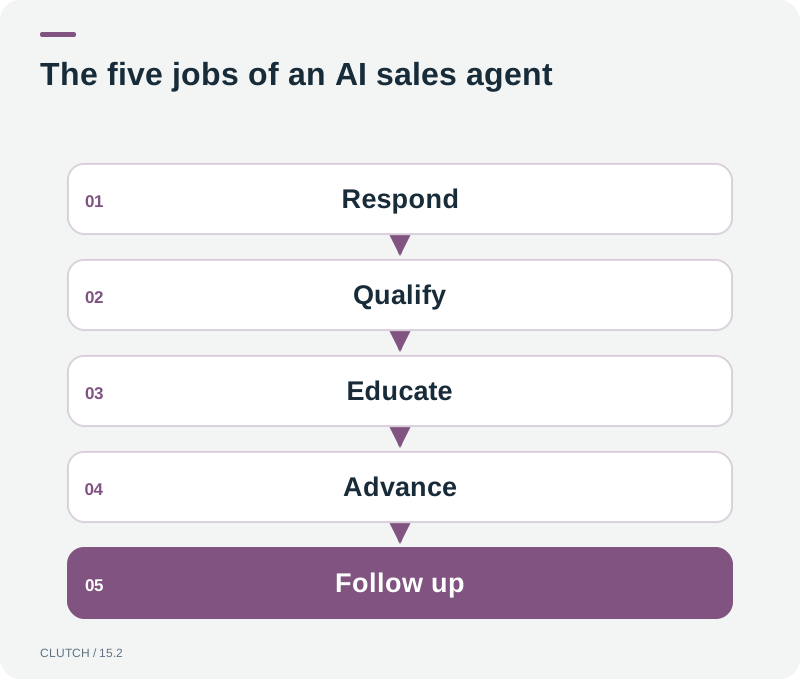
Clutch defines an AI Sales Agent by five core jobs, plus one supporting function. Each job represents a stage in the sales process where the system can reduce manual work, improve response time, or increase consistency.
The Five Jobs: respond, qualify, educate, advance, and follow up, with documentation as a supporting capability.
1. Respond
When a lead arrives, the AI Sales Agent engages quickly. Speed to lead is one of the strongest predictors of conversion. A lead that receives a response within minutes is more likely to convert than one that waits hours. The agent can respond through whichever channel the lead used: a phone call back, a text message, an email, or a website chat. The first response confirms receipt, sets expectations, and begins the qualification process.
2. Qualify
The agent gathers the information required to determine whether the prospect fits the business's criteria. For an HVAC company, that might include the type of service needed, the location, the age of the equipment, and whether the prospect owns the property. For a law firm, that might include the case type, the jurisdiction, and the timeline. The agent asks approved questions, captures the answers, and applies rules to determine whether the lead is qualified, unqualified, or needs more information.
3. Educate
The agent answers approved questions about the company's services, process, pricing guidelines, availability, and common concerns. It is trained on the business's knowledge base, so it can address the questions that prospects ask most often without requiring a human to repeat the same answers. For questions outside its knowledge, it can acknowledge the limitation and route to a human who can help.
4. Advance
The agent moves the qualified lead toward the next step: booking an appointment, requesting an estimate, scheduling a consultation, or connecting with a human salesperson. It can access calendar availability, propose times, confirm bookings, and send confirmations. The advancement is the point where the automated system hands the qualified opportunity to the human sales process.
5. Follow Up
Not every lead converts on the first contact. The agent follows up with leads that did not respond, were not ready, or needed time. It can send a text the next day, an email later in the week, or make a call to re-engage. Follow-up is where most businesses lose opportunities, because humans are inconsistent. An AI Sales Agent follows up on every lead, every time, without forgetting, getting distracted, or deprioritizing.
6. Document (Supporting)
When properly integrated with a CRM, the agent updates records with notes, outcomes, call summaries, tags, and pipeline information. Every interaction is documented so the human sales team has context when they take over. The documentation reduces the need for salespeople to manually enter data and ensures that no information is lost between the automated system and the human conversation.
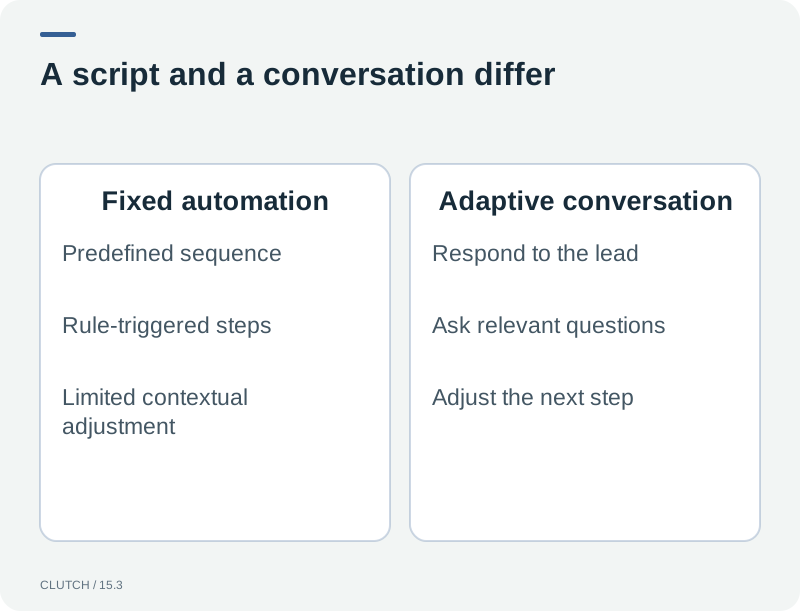
AI Sales Agents adapt conversations based on responses, unlike rigid linear automation that follows a fixed script.
Communication Channels
AI Sales Agents can operate across multiple channels depending on the platform and configuration. Voice allows the agent to make and receive phone calls, carrying on a conversation to qualify and book. SMS enables text-based follow-up and engagement, which often has higher response rates than email. Email supports longer-form communication, document sharing, and nurturing sequences. Website chat provides real-time engagement for visitors who are actively on the site. Social messaging may be supported on certain platforms for leads arriving through social channels.
The most effective implementations use multiple channels together. A lead fills out a website form, the agent calls within minutes. If the call goes to voicemail, the agent sends a text. If the text gets no response, the agent follows up by email. The multi-channel approach increases the likelihood of reaching the prospect and reduces dependence on any single communication method.
Inbound vs. Outbound Use Cases
Inbound use cases involve leads who initiate contact: they fill out a form, call the business, or start a chat. The AI Sales Agent responds, qualifies, and advances. Outbound use cases involve the agent initiating contact: following up with old leads, re-engaging past customers, or reaching out to prospects in a list. Both are valuable, but inbound is where AI Sales Agents typically deliver the most immediate impact, because the lead has already expressed interest and speed of response directly affects conversion.
AI Sales Agent vs. Chatbot vs. CRM Automation vs. Human Sales Rep
Capability
AI Sales Agent
Chatbot
CRM Automation
Human Sales Rep
Communication
Voice, SMS, email, chat
Chat only, usually website
Email, SMS, scheduled
Phone, email, in person
Conversation Flexibility
Adaptive, responds to answers
Rigid, follows a script tree
None, sends fixed messages
Fully adaptive
Qualification
Yes, asks and evaluates answers
Limited, collects form data
No, triggers based on data
Yes, uses judgment
Follow-Up
Yes, multi-channel, persistent
No, session-based only
Yes, but rigid sequences
Yes, but inconsistent
Appointment Booking
Yes, with calendar integration
Rarely, usually links out
No, sends reminders only
Yes
CRM Updates
Yes, when integrated
No
Yes, that is its core function
Yes, but manually
Complex Negotiations
No, routes to human
No
No
Yes
Relationship Building
Limited
None
None
Yes, primary strength
Availability
24/7
24/7
24/7
Business hours
Human Judgment
No, follows configured rules
No
No
Yes
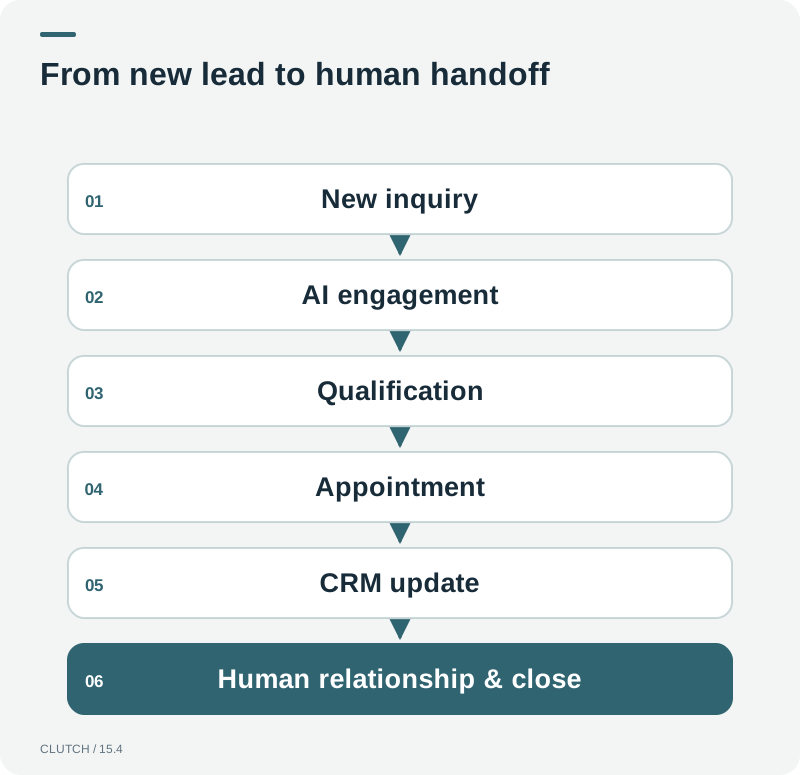
The AI Sales Agent handles the early stages. The human salesperson handles the relationship, negotiation, and close.
Practical Examples Across Industries
The following hypothetical examples illustrate how AI Sales Agents function in different business contexts. These are illustrative scenarios, not based on actual client data.
HVAC Company
A homeowner fills out a form requesting AC repair. The AI Sales Agent calls within two minutes, asks about the symptoms, confirms the address is in the service area, and books a service window through the integrated calendar. The homeowner receives a text confirmation and a reminder the morning of the appointment. If the call goes to voicemail, the agent sends a text offering to book by text. The CRM records the lead source, service type, and booking outcome.
Roofing Company
A property owner calls about a roof replacement. The AI Sales Agent answers, asks about the roof type and age, confirms the property is within the service region, and schedules a free inspection. The agent sends a follow-up email with preparation tips and what to expect during the inspection. After the inspection, the agent follows up to schedule the estimate review. Leads that do not book within two weeks receive a nurturing sequence about roofing materials and financing options.
Law Firm
A potential client submits a consultation request through the website. The AI Sales Agent calls to gather initial information: the type of legal matter, the jurisdiction, and the timeline. The agent applies the firm's qualification criteria to determine whether the case fits the practice area. Qualified leads are routed to the appropriate attorney's calendar. The agent documents the initial intake in the CRM so the attorney has context before the consultation.
B2B Company
A decision-maker downloads a guide from the website. The AI Sales Agent sends a personalized email referencing the guide and offering a discovery call. The agent follows up by text two days later. When the prospect responds, the agent qualifies based on company size, industry, and current solution. Qualified prospects are routed to a sales rep with the full context of the prospect's engagement history. The agent continues nurturing unqualified leads with relevant content.
Medical or Physical Therapy Office
A patient calls to schedule an initial evaluation. The AI Sales Agent answers, confirms the insurance is accepted, collects basic intake information, and books the appointment. The agent sends a text with preparation instructions and a reminder the day before. After the visit, the agent sends a follow-up requesting a review and checking on progress. The CRM tracks patient source, treatment type, and outcomes.
Can AI Sales Agents Replace Salespeople?
No, and that is not the goal. AI Sales Agents handle the repetitive, time-sensitive, high-volume parts of the sales process: responding immediately to every lead, asking the same qualification questions consistently, following up without forgetting, and booking appointments at any hour. The consultation, the proposal, the negotiation, and the close remain human activities that require trust, judgment, and relationship-building.
The better framing is capacity and coverage. An AI Sales Agent provides the capacity to respond to every lead without adding headcount. It provides coverage outside of business hours, during peak periods, and when the human team is busy. It provides consistency where humans are naturally inconsistent. The salesperson's time is freed for the conversations that actually require human judgment, rather than spent on the repetitive work of initial response and qualification.
What Happens When the Agent Does Not Know an Answer?
The agent should be configured to acknowledge when it does not know something rather than guessing. A well-designed AI Sales Agent will say it needs to check, offer to route the question to a human, or take the prospect's information and follow up with the answer. Pretending to know or providing incorrect information damages trust and can create liability. The system's value comes from handling what it knows well and escalating what it does not, not from attempting to answer everything.
AI Sales Agent Readiness Checklist
Does the business receive enough lead volume to justify automation?
Are leads currently going unanswered or receiving slow responses?
Is follow-up inconsistent or dependent on individual memory?
Does the business have a defined qualification process that can be encoded?
Can the booking process be connected to a calendar system?
Is the CRM capable of receiving automated updates?
Are there common questions the team answers repeatedly that could be automated?
Is there a clear handoff point where a human should take over?
Frequently Asked Questions
Frequently Asked Questions
Can AI Sales Agents make phone calls?
Yes, depending on the platform. AI Sales Agents can place outbound calls to new leads, follow up with existing leads, and carry on voice conversations to qualify and book appointments. The capability depends on the specific platform, its voice technology, and its integration with the business phone system. Not all AI Sales Agents support voice, so businesses should verify this capability before selecting a platform.
Can AI Sales Agents receive phone calls?
Yes, on platforms that support inbound voice. The agent can answer incoming calls, engage the caller in conversation, qualify the lead, and book or route as needed. This is particularly valuable for after-hours coverage and overflow during peak call times. Businesses should confirm the platform supports inbound voice and test the call quality before launch.
Can AI Sales Agents book appointments?
Yes, when integrated with a calendar system. The agent can check availability, propose times, confirm bookings, and send confirmations and reminders. This is one of the most valuable capabilities because it shortens the time between interest and appointment without requiring a human to manually schedule.
Can AI Sales Agents handle complex objections?
Not in the way a human salesperson can. AI Sales Agents can handle common, anticipated objections that are part of their training data. For complex, unexpected, or emotionally nuanced objections, the agent should route to a human who can address the concern with judgment and empathy. The system handles the predictable. The human handles the complex.
Can AI Sales Agents follow up with old leads?
Yes. One of the strongest use cases is re-engaging leads that went cold. The agent can work through a list of past leads, reach out by text or email, and identify those who are now ready to move forward. This recovers opportunities that would otherwise be permanently lost and requires no human time until a lead responds.
What businesses benefit most from AI Sales Agents?
Businesses with high lead volume, time-sensitive conversions, multi-step qualification, and significant cost from missed or slow responses benefit most. Home services, law firms, healthcare, financial services, and B2B companies with inside sales processes all tend to see strong returns. Businesses with very low lead volume or a purely relationship-based sales model may not see the same value.
How should human handoff work?
The handoff should include context. When the AI Sales Agent routes a qualified lead to a human, the CRM should contain the full conversation history, qualification answers, and the reason for the handoff. The human should know what the prospect asked, what the agent already covered, and what the next step should be. A handoff without context forces the prospect to repeat themselves and erodes trust.
Should customers be told they are speaking with AI?
Transparency is generally the better practice. Disclosure builds trust and manages expectations. Some businesses prefer to frame it as an automated assistant or a virtual team member. The approach may depend on the industry, the audience, and applicable regulations. Businesses should consult appropriate legal counsel regarding disclosure requirements in their jurisdiction.
Evaluate where an AI Sales Agent could strengthen lead response, qualification, booking, and follow-up.
An AI Sales Agent is not a replacement for your sales team. It is the infrastructure that ensures every lead gets a fast, consistent, qualified response so your human salespeople spend their time on the conversations that actually require human judgment.
Tags:#AI Sales Agent#AI sales agents#AI sales automation#AI lead follow up#AI appointment setter#AI SDR#automated lead qualification#AI sales team
READY TO PUT AI TO WORK?
What Could an AI Sales Agent Do for Your Business?
Every business handles leads differently. We'll look at your current sales process, lead volume, response times, follow-up, staffing, and opportunities to determine where an AI Sales Agent could have the biggest impact.
A Smart Website is connected to the systems that handle lead capture, qualification, routing, follow-up, and measurement. Learn the six capabilities that separate it from a traditional brochure site.
The right destination for your traffic depends on source, intent, awareness, and offer complexity. Learn the Traffic Destination Matrix and when to use each architecture.